
The best programmable thermostat is the one that matches your system's wiring and voltage, then runs a schedule that fits your week. For a furnace with central air, pick a 7-day heat and cool model. If your routine changes often, a Wi-Fi model fits better. Boilers and gas wall heaters need a heat-only unit, heat pumps need a model with a reversing valve terminal, and electric baseboards need a line-voltage thermostat.
Best Programmable Thermostats for Chicago Homes
Most buying guides rank brands, but a best rated programmable thermostat is useless if it does not support your equipment. In Chicago, winters run cold and summers turn hot and humid, so one thermostat often controls both heating and cooling. A mismatch shows up fast as a blank screen or a system that will not shut off. This guide sorts five types by the system they control, so you can match your setup before you spend anything.
Modern HVAC Tech has serviced heating and cooling systems in Chicago and the north suburbs for more than twenty years, and the compatibility checks below come from that work.
Which programmable thermostat fits your system?
| Thermostat type | Best fit | Skip it if |
| 7-day heat and cool | Gas furnace with central AC and a steady weekly routine | Your schedule changes week to week, or you heat with a boiler and have no AC |
| Wi-Fi programmable | Shift work, travel, or a second home you adjust remotely | Your wiring has no common wire and you do not want to add a power adapter |
| Heat-only | Boilers, radiators, furnaces without AC, and millivolt fireplaces or wall heaters | You have central air conditioning or a heat pump |
| Heat pump | A ducted heat pump, with or without backup heat | You have electric baseboards, or a ductless mini-split with its own controller |
| Line-voltage | Electric baseboard heaters in apartments, additions and basements | Your system is low-voltage, such as a furnace, boiler or central air |
1. 7-day heat and cool programmable thermostat
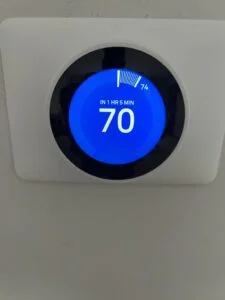
A 7-day heat and cool model is the safest pick for a home with a gas furnace and central air conditioning. As a programmable thermostat for furnace and AC use, it controls both systems from one wall unit and follows a separate schedule for every day of the week.
How the schedule works
You choose heat, cool or auto, then set a start time and target temperature for each period of the day. Most models store four periods, usually wake, leave, return and sleep. On a cooling-only system, a programmable thermostat for air conditioning works the same way: set it to cool and leave heat off. Boxes may call it a programmable AC thermostat or a programmable air conditioner thermostat, and the product is the same.
A schedule only saves money when it matches how you actually live, so program it around your real week.
Terminals and scheduling options to check
Look for the terminals your system uses, typically R, W, Y and G, and confirm the box lists them. Brands such as Honeywell Home and Emerson sell models in this category. Choose 7-day over 5-2 scheduling if your weekends differ by day.
2. Wi-Fi programmable thermostat
A Wi-Fi programmable thermostat is the best pick if your schedule shifts from week to week. It runs the same on-device schedule as a basic model, then adds app control from anywhere, which suits shift workers, frequent travelers, and owners of rentals or second homes.
What the app adds
You edit the schedule on your phone and change the temperature when you are away. Many models also work with Alexa, Google Assistant and Siri, and the ecobee Smart Thermostat Enhanced is one example that lists all three. In addition, usage reports show how long your heating and cooling ran.
Programmable, smart and digital: what the labels mean
A programmable model follows fixed times you set. A smart model adds features such as learning your habits or reacting to whether you are home. The lines blur because most Wi-Fi units are a programmable smart thermostat that does both. Almost every programmable thermostat sold today is digital, so a programmable digital thermostat is just the normal modern version, and the word mostly separates it from the old mechanical dial.
Power and wiring to confirm
You can replace a regular thermostat with a smart programmable thermostat on most low-voltage systems, but Wi-Fi models need constant power, so many require a C-wire. Check your wall wiring for a common wire before you buy, and see whether the box includes a power adapter if you lack one.
Before you buy any Wi-Fi thermostat, check your wall wiring for a common wire.
3. Heat-only programmable thermostat
A heat-only programmable thermostat is the right choice when your system has no air conditioning. That describes many older Chicago buildings with boilers and radiators, along with homes that rely on gas fireplaces or wall heaters.
How a programmable heating thermostat works
A programmable thermostat for heating only, sometimes labeled a programmable heater thermostat, uses two wires, R and W, and simply calls for heat on schedule. Gas fireplaces and some wall heaters run on millivolt systems instead. They need a thermostat rated for millivolt use, because a standard low-voltage model will not work.
Why radiators change the schedule
Radiators respond slowly. A hot water or steam system can take much longer to warm a room than forced air. Keep setbacks modest, around 3 to 5 degrees, and start the warm-up well before you wake or get home. A small setback with an early warm-up beats a deep overnight drop.
What to check before buying
Read the box for "heat only" and for millivolt support if you need it. Confirm whether your boiler needs a thermostat that handles its specific control type. Finally, if the old unit has only two wires, do not buy a model that requires four.

4. Heat pump programmable thermostat
A heat pump programmable thermostat is required when your outdoor unit both heats and cools, because a standard heat and cool model can run the wrong mode. It fits ducted heat pumps for year-round comfort and is the right replacement when an older heat pump thermostat fails.
How it works
Heat pumps use a reversing valve to switch between heating and cooling. The thermostat controls it through an O/B terminal. Most heat pumps also have backup heat, which the thermostat calls through an auxiliary terminal such as W2 or AUX. Backup heat is expensive to run, and a big morning temperature jump can trigger it. Use setbacks of 2 to 3 degrees or choose a model with gradual recovery.
Ductless mini-splits
Ductless mini-splits are different. They usually ship with their own remote or controller, so ask the manufacturer before you wire any wall thermostat to one.
What to check before buying
Look for "heat pump" on the packaging and for O/B and auxiliary terminals. If you cannot tell which system you have, the wire labels on your old thermostat, such as O or B and W2 or AUX, are the quickest clue.
5. Line-voltage programmable thermostat
A line-voltage programmable thermostat is the only correct choice for electric baseboard heaters, since standard thermostats cannot handle their 120 or 240 volt load. It suits apartments and condos, and rooms with their own electric heater such as additions and basements. Each heater or zone gets its own thermostat, so you can run separate schedules by room.
How it works
Line-voltage models sit directly in the heater's power circuit instead of sending a low-voltage signal. Most have four wires, two for the incoming line and two for the heater. Some zones use two wires. You can still set a daily schedule, and a programmable thermostat for electric heat saves most in rooms you rarely use.
Wiring live circuits carries a shock risk, so turn off the breaker and test the wires first, or hand the job to a professional. Never connect a low-voltage thermostat to a baseboard heater circuit.
What to check before buying
Match the voltage, 120 or 240, to your circuit. Check that the maximum load rating covers your heater's total wattage. Confirm the wire count before you buy.
Pick by system, then by features
Photograph the wiring behind your current thermostat and read the labels on your furnace, boiler or outdoor unit. Those two clues tell you which programmable thermostat for home use applies, and they prevent a return trip to the store. The same check works for any programmable thermostat for HVAC equipment, from a basic digital programmable thermostat to a smart one.
If you are unsure what you have, or you do not want to touch the wiring, our licensed technicians can identify your system and install the right unit. Book a thermostat installation with Modern HVAC Tech and get a schedule that fits your home and your bill.
You can also find the summarized version in or Pinterest Pins. Read other blogs in our Blogger , Reddit and Medium Page as well.
Many basic models run on AA batteries, and hardwired models often use them as backup. Replacing them about once a year is a good habit. During an outage the thermostat usually keeps your schedule, but your furnace or AC cannot run until power returns.
On a standard low-voltage system, many homeowners can swap one. Turn off power at the furnace, photograph the wires, and match each labeled wire to the new base. Millivolt systems, boilers with unusual controls and electric baseboard heaters are better left to a professional.
No. Each system needs a thermostat built for its voltage. A home with a furnace and a baseboard-heated addition needs a low-voltage model for the furnace and a line-voltage model for each baseboard zone.