Gas Furnace Valve Replacement Cost: What You Should Pay

The gas valve is the part that opens to feed natural gas or propane to your burners and closes to cut off the fuel when something goes wrong.

Gas furnace valve replacement cost usually lands between $300 and $950 installed, and quotes across the country run from $200 to $900 at the edges.
Because of that spread, a $450 quote and a $950 quote can both be fair, while some other quote deserves questions. This article explains why the price varies, whether DIY is worth the risk, and what to rule out before you pay for a new valve.

In fact, Modern HVAC Tech has repaired furnaces in Chicago and the north suburbs for over twenty years. The ranges below come from published pricing guides

Why gas furnace valve replacement cost varies

Because of that spread, a $450 quote and a $950 quote can both be fair, while some other quote deserves questions. This article explains why the price varies, whether DIY is worth the risk, and what to rule out before you pay for a new valve.

In practise, repair is rarely the better deal. In some cases a sticking valve can sometimes be cleaned or repaired, but a technician usually recommends replacing the valve outright because the savings are small and the safety stakes are high.

What moves your quote up or down

Overall, your furnace and your timing matter as much as the valve. Specifically, these are the factors that change the number:

  • Furnace type. Single-stage valves are the cheapest. In contrast, two-stage and modulating furnaces use more complex valves that cost more.
  • Part source. For example, a manufacturer part for a Carrier, Trane or Lennox furnace costs more than a universal valve from a maker like Honeywell. However, a universal valve only works if its fuel type, stages and connections match your furnace.
  • Access. In addition, a valve that sits behind other components takes longer to reach, and labor rises.
  • Timing. Generally, evenings, weekends, and holidays carry a premium over a scheduled weekday visit. On the other hand, booking in fall, before heating season is in full swing, usually costs less.
  • Related damage. Finally, a bad valve sometimes comes with a failed manifold, ignitor or control board. As a result, a $500 job becomes a $1,200 job.

How to check whether your quote is fair

Ask for an itemized quote

Unfortunately, a single lump sum hides the information you need. For that reason, ask for these items before you approve the work :

  1. The valve's brand and whether it is OEM or universal.

  2. The part price and the labor charge listed separately.

Fortunately, any honest contractor can answer these on the spot. At Modern HVAC Tech, for instance, upfront pricing is how we quote , and you should expect the same from anyone you hire.

DIY versus professional gas valve replacement

Overall, hire a licensed professional. Doing it yourself might save $200 to $500 in labor, but a bad connection on a gas line can cause a leak, a fire or carbon monoxide exposure.

What DIY really saves

However, the savings only exist if the job goes perfectly. Besides, you still pay for the part, and you need the tools to test the work afterward. In addition, gas work also carries local rules, and many cities restrict it to licensed contractors, so check with your building department.

Factor

DIY

Licensed professional

Safety risk

Gas leak, fire, carbon monoxide

Leak-tested and verified

Warranty

May void the equipment warranty

Part and labor warranty available

Tools and testing

You supply them

Included in the visit

Rules and permits

You must check local requirements

Handled by the contractor

What a technician does on the visit

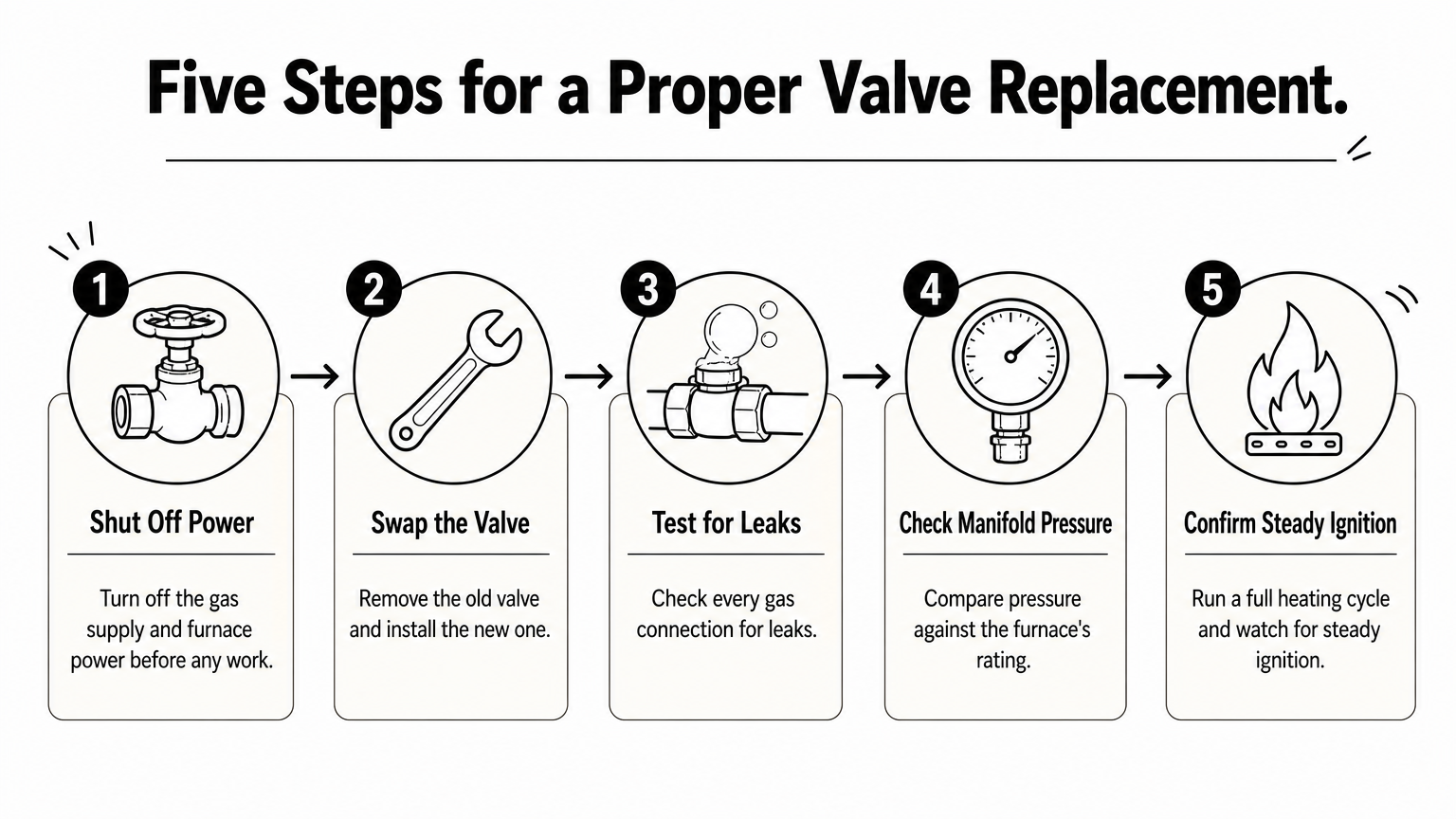
A five-step process diagram showing the order a technician follows to replace a furnace gas valve safely.

In general, a proper replacement follows a set order, and knowing it helps you tell a thorough visit from a rushed one:

  1. Shut off the gas supply and the furnace power.
  2. Disconnect and remove the old valve, then install the new one.
  3. Test every gas connection for leaks.
  4. Check manifold gas pressure against the furnace's rating.
  5. Run a full heating cycle and confirm steady ignition.

Above all, if you ever smell gas, leave the house immediately and call your gas utility or 911 from outside. Likewise, do not flip switches or try to repair anything yourself.

Ultimately, the labor you save by doing it yourself is the cheapest part of the job to give up and the costliest to get wrong.

Signs of a failing gas valve and what to do next

As a rule, gas valves typically last 10 to 20 years, and a failing one tends to show up as ignition trouble, short cycling or weak heat. Because, these symptoms overlap with other furnace faults, so diagnose before you buy a part.

Symptoms and what else could cause them

Furnace Maintenance in Chicago

Therefore, watch for these signs of a bad valve:

    • The furnace does not ignite, or the igniter clicks with no flame.
    • The furnace short cycles, running in brief bursts and shutting off.
    • Air from the vents is cooler than normal, so the furnace seems to be blowing cold air.
    • Your gas bill climbs without an explanation.
    • You hear unusual clicking from the valve itself.
    • You smell gas. Leave the house immediately, call your gas utility or 911 from outside, and do not flip switches.

For instance, a bad flame sensor, a failing thermocouple, a dirty filter, or a thermostat fault can cause the same symptoms, so a technician should test those first. Doing so is also the best protection against paying for a valve you did not need.

Warranty coverage and when to replace the furnace

Also, check warranties before you pay. Keep in mind that a manufacturer's warranty often covers the part but not the labor, so you may still owe the labor cost, and a home warranty plan may cover both.

Next, think about the whole furnace when the unit is old. First, if the valve is the only failure on a healthy furnace, replace the valve. Otherwise, use the $5,000 rule: multiply the repair quote by the furnace's age in years, and if the result tops $5,000, replacement is the better spend. For example, a $600 valve job on a 6-year-old furnace scores $3,600, so repair it. By contrast, the same quote on a 15-year-old furnace scores $9,000, so compare it with the figures in our furnace replacement cost guide, which run $5,500 to $8,500 for most Chicago homes.

In summary, diagnose first, replace the valve second, and only consider a new furnace when the valve is one of the several failures. 

Bottom line on gas valve replacement costs

In short, before you approve a quote, confirm the technician tested the other likely causes and listed the parts  clearly. Additionally, if the furnace is older, run the $5,000 rule against the total before you decide.

Finally, if your furnace is not igniting or you want a second opinion on a quote, book a furnace repair diagnosis with Modern HVAC Tech. That way, you get a clear price before any works begins.

What Size Furnace Do I Need

If your furnace has stopped cooling and you want an honest answer on which route fits your home, book an AC repair diagnosis with Modern HVAC Tech. We serve Chicago and the north suburbs.

You can also find the summarized version in or Pinterest Pins.
Read other blogs in our Blogger , Reddit and Medium Page as well.

In most cases, replacements take about one to two hours, including leak testing, a manifold pressure check, and a full heating cycle. Meanwhile, hard-to-reach valves or related damage can add time.

No. Specifically the shutoff valve on the supply line is a manual valve you turn by hand. By contrast, the gas valve inside the furnace is the electrically controlled part that opens and closes to feed the burners, and it is the one this article prices.

Overall, a failed valve is much less common than igniter or flame sensor trouble. In fact, some valves first show a problem when the furnace starts up after a long summer off, which is another reason technicians test the simpler causes first.